How to Add Healthier Frozen Dessert Options to Your Menu
March 1, 2026
Top Features That Make Two-Sided Grills a Must for High-Volume Kitchens
March 5, 2026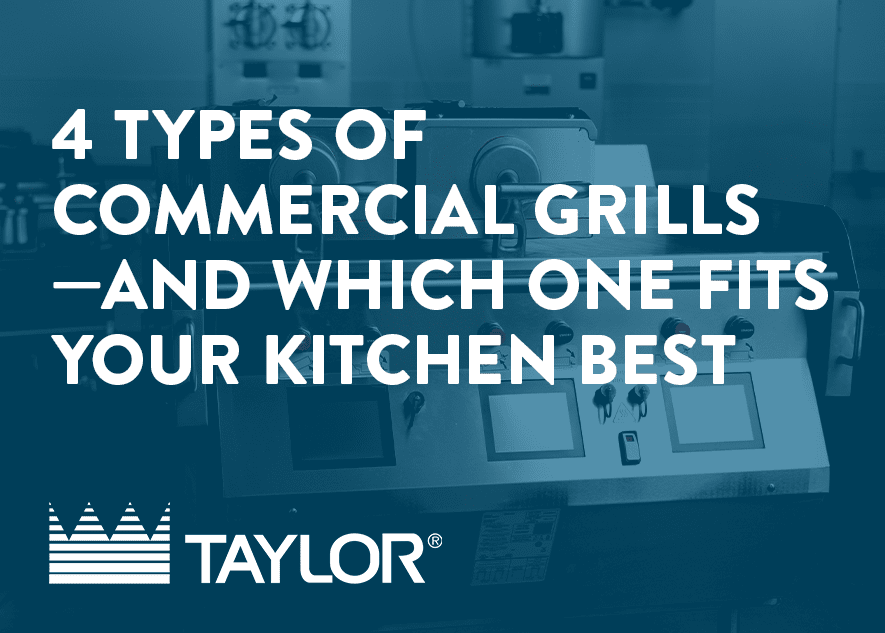
4 Types Of Commercial Grills—and Which One Fits Your Kitchen Best
There is always a lot happening in a busy kitchen. Orders come in fast. Staff move quickly. Customers expect their food to be hot, fresh, and consistent every time.
In the middle of all that, your grill plays a bigger role than you might think. The right grill helps your team work faster, stay organized, and deliver the same quality plate after plate. The wrong one can slow everything down.
If you are trying to find the best commercial grill for your restaurant, it helps to understand the main types of commercial grills and what each one does best.
This guide walks through the most common options and explains how Taylor’s Crown Series two-sided grills support high-volume kitchens.
What Are the Main Types of Commercial Grills?
Before choosing a grill, it helps to understand the main commercial grill types used in high-volume kitchens. While several options exist, performance needs often determine which one truly supports a busy operation.
1. Flat Top Grills/Griddles
Flat top grills, also referred to as griddles, use an open cooking surface that heats from the bottom only. They are commonly used for burgers, eggs, and sandwiches.
Flat tops are familiar and simple to operate. However, they rely heavily on staff timing and manual flipping. Cooking speed, doneness, and consistency can vary depending on who is working the grill. During peak periods, this can slow output and increase the chance of overcooking or uneven results.
For lower-volume operations, flat tops may work well. But in high-output kitchens, many operators look for equipment that reduces guesswork.
2. Crown Series Two-Sided Electric Grills
Taylor’s Crown Series line of grills is built for busy kitchens that need speed, consistency, and confidence. With one-touch menu selection, these grills automatically set the right time, temperature, and gap, so staff can focus on service instead of constant adjustments. Programmable controls also make training faster and results more reliable.
Precise automatic gapping and independent cooking zones help food cook evenly without flavor transfer. That means you can run different menu items at different temperatures all day long, without slowing down.
Crown Series models include:
- L858 Crown Series Three Platen Electric Double-Sided Grill
- L852 Crown Series Two Platen Electric Double-Sided Grill
- L850 Crown Series Single Platen Electric Two-Sided Grill
These grills are built to help high-volume restaurants maintain strong output without sacrificing quality.
3. Gas-Powered Two-Sided Grills
For kitchens that prefer gas heat, Taylor offers dependable two-sided grills built to keep up during busy service.
Models include:
- L811 Gas Three Platen Two-Sided Grill
- L813 Gas Two Platen Three Lane Two-Sided Grill
- L819 Gas Two Platen Two-Sided Grill
With weighted platen options, automatic gapping, and programmable controls, these grills help food cook quickly and evenly. Separate cooking zones also make it easier to manage multiple items when the line is full.
4. Electric Two-Sided Grills
In addition to the Crown Series, Taylor offers a range of electric two-sided grills that deliver consistent top-and-bottom heating and programmable performance.
Models include:
- L810 Electric Three Platen Two-Sided Grill
- L812 Electric Two Platen Three Lane Two-Sided Grill
- L820 Electric Two Platen Two-Sided Grill
- L828 Electric One Platen Two-Sided Grill
These models help simplify operation, reduce manual handling, and maintain even cooking across shifts.
Flat Top Grill vs Clamshell Grill: What’s the Real Difference?
When operators compare equipment, one of the most common questions is about the flat top grill vs clamshell grill debate.
Here is a simple restaurant grill comparison.
Flat top griddles:
- Cook from one side
- Require manual flipping
- Depend more on staff experience
- Take longer for thick proteins
Clamshell grills:
- Cook from both sides
- Reduce flip time
- Improve portion consistency
- Speed up service
Flat tops still work well in many kitchens. But when speed and uniformity matter most, clamshell grills usually offer an advantage.
What Type of Grill Works Best for High-Volume Kitchens?
High-volume kitchens face unique challenges. During peak periods, every second counts. Orders stack up quickly, and small delays can turn into long lines.
For many QSRs, cafeterias, and multi-unit operators, the best commercial grill for restaurant performance comes from two-sided cooking.
Taylor’s Crown Series models are designed for this environment, allowing kitchens to maintain output without sacrificing food quality.
Are Two-Sided Commercial Grills Worth the Investment?
Upgrading equipment is always a major decision. It makes sense for operators to want to be sure that a two sided commercial grill is worth the cost.
In most high-output kitchens, the answer comes down to long-term value.
Two-sided grills help by:
- Reducing cook times
- Limiting overcooking
- Lowering remake rates
- Simplifying training
- Improving portion control
A commercial clamshell grill also helps reduce stress during rushes. When food cooks evenly and predictably, staff can focus on service instead of constantly checking temperatures.
Over time, these benefits make the initial investment pay off.
Which Commercial Grills Cook Fastest?
Speed matters most when the line is full and tickets keep printing.
Two-sided grills cook faster because heat is applied from both directions. This allows food to reach safe internal temperatures more quickly without drying out.
Taylor Crown Series grills use precise platen pressure and programmable settings to optimize this process.
Models like the L819 Gas Two Platen Grill and the L820 Electric Two Platen Grill are built to maintain performance even during extended peak periods.
Faster cooking means:
- Shorter wait times
- Higher throughput
- Better guest satisfaction
What to Consider When Choosing a Restaurant Grill
Before selecting a grill, it helps to think through how it will fit into your operation.
Here are a few practical questions to ask:
How much volume do you serve each day?
What menu items rely most on the grill?
How experienced is your staff?
How much time can you dedicate to cleaning and maintenance?
Do you have reliable service support?
Grills with programmable controls and durable construction are often easier to manage long-term.
Access to parts and maintenance support also plays an important role in keeping equipment running.
Why Taylor Grills Stand Out
Most grills can cook food. Fewer can deliver speed, consistency, and control at scale.
Taylor’s Crown Series grills are designed to support demanding foodservice environments by offering:
- Programmable cook cycles
- Independent cooking zones
- Precise top-and-bottom heating
- Easy-to-clean platen surfaces
- Durable construction
These features help operators deliver consistent results regardless of who is working the line.
In a restaurant grill comparison, these factors often separate standard equipment from high-performance tools.
Try Taylor’s Commercial Grill Selector
Choosing the right grill does not have to be complicated.
Taylor’s Commercial Grill Selector helps operators narrow down options based on volume, menu, and kitchen layout. It provides a guided way to find the best-fit model for your operation.
If you are unsure where to start, this commercial grill selector tool can save time and simplify the decision process.
Choosing the Right Grill for Your Kitchen
Every kitchen is different. The right grill depends on your volume, menu, staff, and service goals.
Understanding the main types of commercial grills makes it easier to choose equipment that supports long-term success. For high-output operations, two-sided grills like Taylor’s Crown Series provide speed, consistency, and control that help teams perform at their best.
When you are ready to explore your options, contact Taylor Company. Our team can help you find the right solution for your operation.